
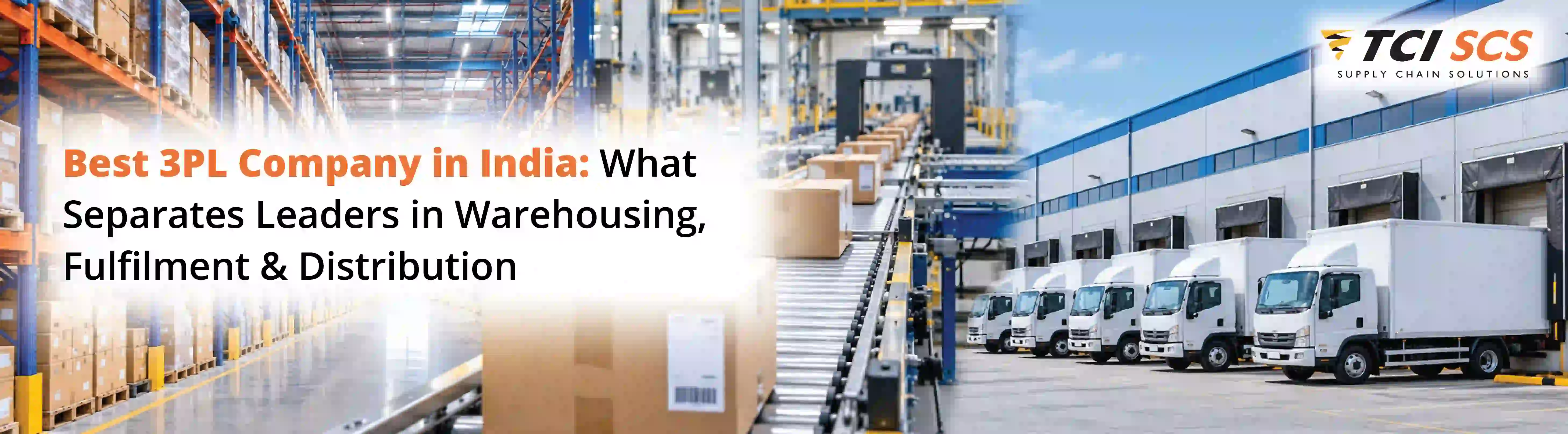
Choosing the Best 3PL Partner in India: Capabilities That Drive Supply Chain Efficiency
The best 3PL company in India is the one that takes over a business's warehousing, fulfillment, and distribution as a single accountable service, with its own sites, systems, and people. It runs them to service levels the business could not reach on its own.
Demand for that service is at a record. Warehousing leasing in India's main markets has grown by more than half in a year, and third-party logistics providers now take the largest share of it. This guide breaks down what 3PL logistics covers, why demand is rising, what separates leaders from space providers, how to verify a provider, the contract terms that matter, and how to choose the best 3PL logistics provider for your business.
Key Takeaways: A 3PL is judged on what it operates, not what it rents - its own warehouses, its warehouse management system, its trained workforce, and the transport network that connects the sites. Leaders publish and hit service levels for inventory accuracy, order accuracy, dock-to-stock time, and on-time dispatch, and they price by activity so the business pays for what it uses. Verify every claim on site and in the system before signing, and run a pilot on one product line or one region before moving the whole network.
A 3PL leader runs a racked, WMS-controlled space where every pallet has a location and a record.
What Is 3PL Logistics and What Does a 3PL Logistics Company Do?
3PL logistics is the outsourcing of warehousing, inventory, order fulfilment, and distribution to a specialist that runs them on the business's behalf. A 3PL logistics company owns or operates the sites, staffs them, runs the systems, and reports against agreed service levels. Its scope usually covers:
- Warehousing: multi-user sheds where several clients share space and labour, dedicated facilities built for one client, and in-plant stores inside a factory.
- Inventory management: receiving, put-away, cycle counting, and stock accuracy reporting through a warehouse management system.
- Order fulfilment: picking, packing, and dispatching business-to-business orders to distributors and dealers, and business-to-consumer orders for e-commerce.
- Distribution: primary movement from plant to warehouse and secondary movement from warehouse to customer, on the provider's own or contracted fleet.
- Value-added services: kitting, labelling, repacking, quality checks, and returns handling.
- Compliance and documentation: road permits, e-way bills, and excise and customs paperwork for the goods it holds and moves.
A 4PL goes one step further and manages other providers on the client's behalf. Most Indian businesses need a strong 3PL first, and the best ones offer 4PL and control-tower services when the network grows.
Why Is Demand for Third Party Logistics Services in India Rising?
Demand for third party logistics services in India is rising because businesses are consolidating stock into fewer, larger, better-run warehouses and handing the operation to specialists. The leasing numbers show the shift. Industrial and warehousing leasing across eight major cities surged 63% to a record 27.1 million sq ft in the first half of 2025, and 3PL providers took 32% of that space, ahead of e-commerce and manufacturing.
Five forces are behind the growth:
- Tax-driven consolidation: GST removed the reason to keep a small depot in every state, so businesses now run a few regional hubs and need providers who can operate them at scale.
- E-commerce and quick commerce: direct-to-consumer orders need fulfilment centres near cities, with picking accuracy and same-day dispatch that a traditional godown cannot deliver.
- Manufacturing growth: production-linked incentives and new plants create inbound, in-plant, and finished-goods logistics that OEMs prefer to outsource.
- Grade A supply: modern, tall, dock-levelled warehouses are replacing sheds, and 3PLs are their anchor tenants.
- Logistics parks: the government has approved 35 multimodal logistics parks, with five due to be operational by 2027, each combining warehousing with road and rail terminals, and 3PL leaders will anchor those too.
Full-year figures confirm the trend. Warehousing transactions across the top eight markets reached 72.5 million sq ft in 2025, with 3PL providers taking 27% of the area and 63% of all deals in Grade A space.
Grade A racking, dock levellers, and 40-foot clear heights are now the standard for 3PL sites.
What Separates the Best 3PL Companies From Warehouse Space Providers?
The best 3PL company in India is separated from a space provider by operations, not by square footage. The table below sets out where the difference shows.
|
Criterion |
What a leader runs |
What a space provider offers |
|
Sites |
Owned or long-leased Grade A warehouses across regions, with dock levellers and racking |
A shed on lease, often single-location |
|
Systems |
A warehouse management system with RF handhelds, paperless put-away and picking, client dashboards |
Spreadsheets and manual registers |
|
People |
A trained, permanent workforce with supervisors and safety programmes |
Casual labour hired by the day |
|
Transport |
Own or group fleet for primary and secondary distribution, with tracking |
A local truck contact |
|
Service levels |
Published targets for inventory accuracy, order accuracy, dock-to-stock, and dispatch, reported monthly |
No measured commitments |
|
Pricing |
Activity-based or per-pallet models that scale with volume |
Flat rent regardless of use |
|
Value-added services |
Kitting, labelling, repacking, returns, and compliance documentation |
Storage only |
A shipper can test the difference in one visit. Ask to see a live pick on the handheld and the inventory accuracy report for last month. A leader shows both in minutes.
How Do You Verify a 3PL Logistics Company's Claims?
You verify a 3PL's claims on the warehouse floor and inside its system, because a proposal cannot show either. Ask every shortlisted provider for:
- A site walk: the actual warehouse your stock will sit in, with the racking, dock levellers, fire systems, and security in place.
- A system demonstration: the warehouse management system running live, from receipt to dispatch, and the reports you will receive.
- Inventory accuracy data: cycle-count results for an existing client over the last quarter, with variances explained.
- Fulfilment metrics: order accuracy, fill rate, and dock-to-stock and order-to-dispatch times from a current operation.
- Safety and compliance records: incident logs, audits, and the licences the site holds.
- Client references: two businesses in your sector you can call, and the length of their relationship.
The strongest signal is tenure. Clients who have stayed with a 3PL for years are the proof that its service levels hold.
What Should a 3PL Contract Cover?
A 3PL contract should fix pricing, service levels, liability, and exit in writing, so that both sides measure the same things. Six clauses matter most:
- Pricing model: per pallet, per order, per unit, or activity-based, with the rate card and the volume bands stated, and inbound, storage, outbound, and value-added services priced separately.
- Service levels: inventory accuracy, order accuracy, dock-to-stock hours, on-time dispatch, and reporting frequency, each with a target and a remedy.
- Liability and insurance: cover for stock in the warehouse and in transit, with the claims process and turnaround written down.
- Systems and data: integration with your ERP, data ownership, and access to dashboards and reports.
- Scalability: how space and labour flex for peak seasons, and the notice needed to add a region.
- Exit and transition: the handover plan and timeline for moving stock out, so the provider never holds your inventory hostage.
The cheapest per-pallet rate is rarely the cheapest contract. Ask for all six clauses before you compare.
Pallet positions, not floor area, are how a 3PL leader prices and manages space.
How Do You Choose the Best 3PL Logistics Provider for Your Business?
You choose the best 3PL logistics provider by matching the provider's operations to your product, your channels, and your growth plan, then proving it on a pilot. A practical sequence:
- Write the brief: SKUs, volumes, order profile, channels, seasonality, and the service levels your customers expect.
- Shortlist providers with sites where you need them: regional hubs near your markets and, if you manufacture, in-plant capability.
- Audit sites and systems: the site walk, the WMS demonstration, and the accuracy and fulfilment data.
- Compare activity-based pricing: with every service priced separately and volume bands agreed.
- Pilot one region or one product line: for one quarter, measured on the service levels in the draft contract.
- Contract and scale: sign for the full scope with quarterly reviews built in.
Run that sequence and the field narrows to providers that operate at scale with their own systems and people. TCIL GROUP is one of them. Through TCI Supply Chain Solutions it manages more than 12 million sq ft of covered warehousing across 100-plus sites, with over 100,000 pallet positions and a workforce of more than 5,000. A warehouse management system with RF handhelds runs paperless put-away and picking at every site.
That operation covers distribution centres, fulfilment centres, and cross-docks, with per-pallet co-warehousing for businesses that want a variable cost model and activity-based costing for those that want to pay by the task. Auto, chemicals, pharma, hi-tech and telecom, cold chain, and omni-channel retail already run on it.
What sets it apart from a standalone 3PL logistics company is what surrounds the warehouse. TCI Freight runs road distribution, TCI Concor the rail legs, TCI Seaways the coastal legs, and TCI Cold Chain the temperature-controlled stock, all inside one group. That is why TCIL GROUP sits among the best logistics companies in India for a business that wants its warehousing, fulfilment, and distribution run by one accountable partner.
Frequently Asked Questions
What is the difference between 3PL and 4PL?
A 3PL operates warehousing, fulfillment, and distribution with its own sites, systems, and people. A 4PL manages the whole supply chain on the client's behalf, including other providers, and often owns no assets. Most businesses need a strong 3PL first and add 4PL services as the network grows.
How is 3PL warehousing priced in India?
Usually per pallet position per month for storage, plus per-unit or per-order charges for inbound handling, picking, packing, and dispatch, with value-added services priced separately. Activity-based models let the business pay for what it uses and scale with volume.
What service levels should I expect from a 3PL?
Inventory accuracy above 99.5%, order accuracy above 99%, dock-to-stock within 24 hours, and on-time dispatch above 98% are common targets in organised Indian 3PL operations. Each should be measured monthly and written into the contract with a remedy.
How long does it take to move to a new 3PL?
A single-site transition typically takes six to twelve weeks, covering systems integration, stock transfer, and staff training, and a phased multi-region move takes longer. A pilot on one region or product line before the full transition reduces the risk.